
Criminal Court Cases in Marshall County
Marshall County is Alabama's 27th Judicial Circuit, and its criminal court files are split by jurisdiction. District Criminal hears county misdemeanors committed outside city limits, worthless-check matters, conservation tickets, Revenue Commission tickets, and Alabama ABC violations. A felony starts in District Court for its preliminary stages. If a grand jury returns an indictment, the felony moves to Circuit Court. The Marshall County Circuit Clerk maintains both District and Circuit case records, including filings, docket entries, dispositions, sentences, and certified-copy functions.
Municipal courts keep their own city dockets. Albertville Municipal Court, for example, handles city ordinances, Albertville police traffic charges, and criminal misdemeanors within its jurisdiction. Boaz and Guntersville also keep municipal ordinance, traffic, and misdemeanor files. Start with the arrest location and the court named on a citation, bond paper, notice, or case number. A city address alone does not prove that the case is municipal.
Marshall County Court Jurisdiction Split
The most useful first choice in a Marshall County court search is not online versus in person. It is county court versus municipal court. A charge from an unincorporated part of Marshall County usually begins in District Criminal. A city ordinance case or qualifying city misdemeanor stays with that city's court. Felony allegations begin in District Court even when an arrest occurred in a city, then move to Circuit Court only after indictment.
| Court | Marshall County criminal role | Record route |
|---|---|---|
| District Court | Preliminary felony stages and county misdemeanors outside city limits | Circuit Clerk |
| Circuit Court | Indicted felonies, later filings, disposition, and sentence | Circuit Clerk |
| Municipal Court | City ordinances, traffic matters, and qualifying city misdemeanors | The named city court |
This Marshall County venue check prevents a common dead end. The sheriff, prosecutor, and clerk each take part in a criminal case, but only the proper clerk is the custodian of the filed court record.
Marshall County Case Record Searches
Two main channels cover Marshall County District and Circuit case records. The account-based Alabama Judicial System Just One Look service charges $9.99 for each name or case-number search, and the service warns that a no-match search may still be billed. The Guntersville Circuit Clerk provides a free public-access computer. The Albertville courthouse provides a second clerk counter, though the research confirms the public terminal only in Guntersville.
- Identify District, Circuit, or municipal jurisdiction from the event location and any court paper.
- Search Just One Look by a person's name or a known case number, or use the free Guntersville terminal.
- Match the court, filing date, charge, and case status instead of relying on the name alone.
- Read the action summary for arraignment, motions, hearings, pleas, disposition, and sentence.
- Ask the proper clerk for copies or a certified disposition when an authoritative outcome is needed.
The public interface can change, so confirm its exact Marshall County search controls on the live screen. The research supports these core search modes and result fields:
| Field or mode | Type | Required | Use |
|---|---|---|---|
| Person or name | Text search | For a name query | Use full spelling and compare identifying case details |
| Case number | Text search | For a case query | Best route when a docket or notice supplies the number |
| Court and location | Result field | Not stated | Confirms the Marshall County venue |
| Case status and action summary | Result detail | Not stated | Shows filed events and the current stage |
Free Marshall County Court Terminal
The Guntersville clerk terminal is the practical alternative when a reader does not want a Just One Look account or repeated search fees. It is at the Marshall County Courthouse, 424 Blount Avenue, Suite 201, Guntersville, AL 35976. The clerk publishes 256-571-7785 and weekday hours of 8:00 a.m. to 4:30 p.m. Bring a precise name, approximate filing or arrest date, and any case number. Call before travel to confirm access and current copy charges.
The second Circuit Clerk counter is at 133 South Emmett Street, Albertville, AL 35950. Its published phone is 256-878-4521, while the phone directory also lists 256-878-4515. Both counters can help with case information and procedure, but staff cannot advise what to file, predict a result, contact a judge privately, or change a signed order.
Marshall County Circuit Clerk
424 Blount Avenue, Suite 201
Guntersville, AL 35976
256-571-7785
Monday-Friday, 8:00 a.m.-4:30 p.m.
Albertville Clerk Counter
133 South Emmett Street
Albertville, AL 35950
256-878-4521
Monday-Friday, 8:00 a.m.-4:30 p.m.
What a Criminal Case File Contains
A Marshall County case file is prosecution-centered. It records the charge as filed, the court's actions, and the final outcome. That differs from a jail booking, which centers on intake, initial charge labels, bond, and release. The case number and court should be checked first because they tie later docket entries to the correct prosecution.
| Case Number and Court | Identifies the District, Circuit, or municipal file and its venue. |
|---|---|
| Charging Document | Shows the complaint, information, or indictment and the charge filed in court. |
| Docket Entries | Lists filings, notices, motions, orders, and other actions by date. |
| Hearing Dates | Records arraignment, pretrial, plea, trial, and sentencing settings when entered. |
| Disposition and Judgment | Shows whether a charge ended in conviction, dismissal, acquittal, nolle prosequi, or another result. |
| Sentence and Conditions | Records custody, probation, community corrections, fines, costs, restitution, and related orders when applicable. |
Marshall County document images and identifiers may be withheld even when a basic docket is public. For a reliable final result, request the certified disposition rather than treating a search summary as the official copy.
Marshall County Alacourt Case Detail
The Just One Look result can organize a Marshall County case into case detail, financial history, and an action summary. Useful fields may include the filing date, case type, status, defendant display, charge description or code, counsel, hearing dates, disposition, sentence, costs, fines, warrant status when entered, and document availability. These fields show different parts of the file. The action summary is the timeline; the disposition states how a charge ended; the financial history records assessed or paid court amounts.
The official Alacourt login screen shows the entry point used for remote Marshall County court case lookups.
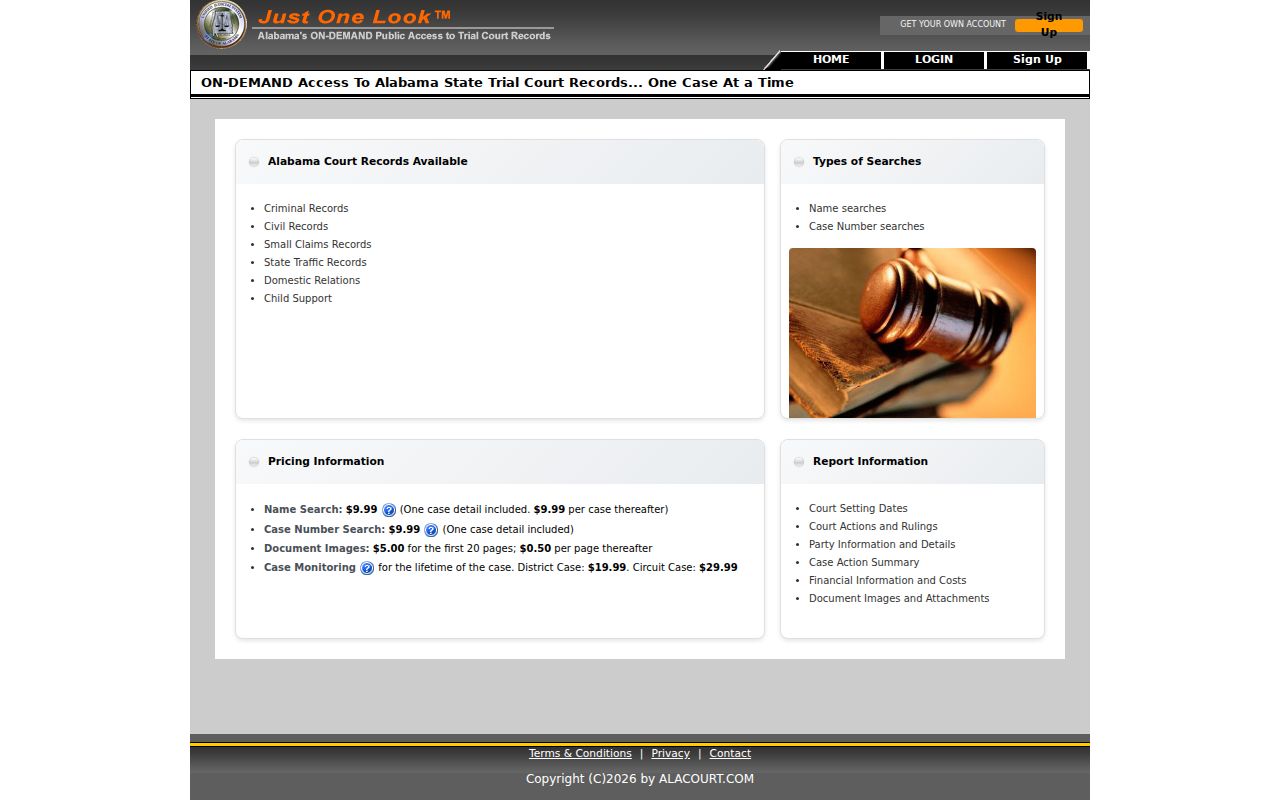
The screen is an access gateway, not proof of a case outcome. Open the correct file and read its dated entries before drawing a conclusion.
Note: Just One Look may charge for a no-match, while the Guntersville clerk terminal provides a free local search route.
Criminal Case Stages in Marshall County
A Marshall County criminal case may start with an arrest or summons, followed by a complaint and initial appearance or bond process in District or Municipal Court. A felony can receive a preliminary hearing and grand-jury review. A true bill is an indictment, which moves the matter into Circuit Court. A no bill means the grand jury did not indict that submission. Arraignment and pretrial filings come next, then a plea, dismissal, or trial. A conviction leads to sentencing and may involve probation, community corrections, jail, or Alabama Department of Corrections custody.
Case flow: Charges Filed › Arraignment › Pretrial › Plea or Trial › Disposition › Sentencing
The Marshall County docket can branch or stop before the final stage. An appeal adds a higher-court record. A dismissal or acquittal is a case outcome, but it does not by itself remove every historical arrest or agency record.
Marshall County Case Outcome Terms
Short court terms can change the meaning of a Marshall County case search. Read each term against the charge-level disposition, since one file may contain more than one count and more than one result.
- True bill
- The grand jury found enough basis to return an indictment. It is not a conviction.
- No bill
- The grand jury did not indict that submission.
- Nolle prosequi
- The prosecutor formally chose not to continue the charge at that time.
- Acquittal
- A not-guilty result after adjudication.
- Disposition
- The recorded way a specific charge ended.
If an ALEA personal history lacks the final court result, obtain a certified disposition from the Marshall County clerk. That document supports a correction request to the agency that maintains the incomplete entry.
Certified Marshall County Case Outcomes
A certified disposition is the best court product when the exact end of a Marshall County charge matters. Give the clerk the case number when possible, or a name and approximate date for archive retrieval. Search and certification prices for local criminal records were not published in the source material, so ask the clerk for the current charge and delivery method before ordering.
When the booking charge and court charge differ, preserve both records rather than choosing the earlier label. The arresting agency records the basis for custody. The prosecutor may later file a different charge, and the clerk records the filed count and final result. The broader Marshall County arrest search explains the agency and jail side of that record chain.
Access Rules for Case Records
Alabama's open-record rules support access to public writings, but they do not make every field or file public. Alabama Code sections 36-12-40 and 36-12-41 address inspection and certified copies. Other laws restrict criminal-justice information, juvenile and youthful-offender matters, victim information, confidential identifiers, and expunged records. A public search can show docket data while withholding protected documents or redacting personal details.
For older or absent Marshall County files, call the proper clerk and provide a case number or a name with an approximate date. The office can explain procedure and check the file, but it cannot give legal advice. If the file is restricted, staff may confirm only what law and the court order permit.